Every other layer tells you what happened.
IO tells you whether it worked.
IO measures whether the intervention actually worked, and tells you when it didn't. The measure is agreed before the work starts, the baseline is captured at approval, and the result is reported afterwards, good, flat or bad.
Your stack produces more signals every quarter and less certainty.
Nobody is short of dashboards. What is missing is anyone able to say, in writing, that last quarter's work changed anything.
Campaigns run, modules completed, tickets closed. None of it answers whether the organisation is safer than it was in January.
The right intervention at the wrong maturity fails, and the method gets blamed instead of the timing.
Without a measure captured before the work, any number produced afterwards can be framed either way.
A closed six-step loop applied to a single signal. Connect: signals arrive from the systems already in place. Correlate: deterministic matching across sources, not inference. Interpret: read against this organisation's environment and maturity. Prescribe: a matched playbook, ranked, with the reason visible. Execute: a named owner accepts it, and the baseline measure is captured at this point, before any work starts. Verify: the original signal is measured again from the same source and the result is recorded either way, as verified, unverified or regressed. The sequence then returns to the signal it started from, so it is a loop rather than a line.
- 01Connect
Signals arrive from the systems already in place.
- 02Correlate
Deterministic matching across sources, not inference.
- 03Interpret
Read against this organisation's environment and maturity.
- 04Prescribe
A matched playbook, ranked, with the reason visible.
- 05Execute← baseline captured
A named owner accepts it, and the measure is captured before work starts.
- 06Verify
The original signal is measured again, and the result is recorded either way.
VerifiedUnverifiedRegressedInconclusive
The dashed path returns, Verify measures the signal that started the sequence, so it closes rather than ending at an outcome.
Eight domains, one operating picture.
Each with its own signals, playbooks and verification measures.
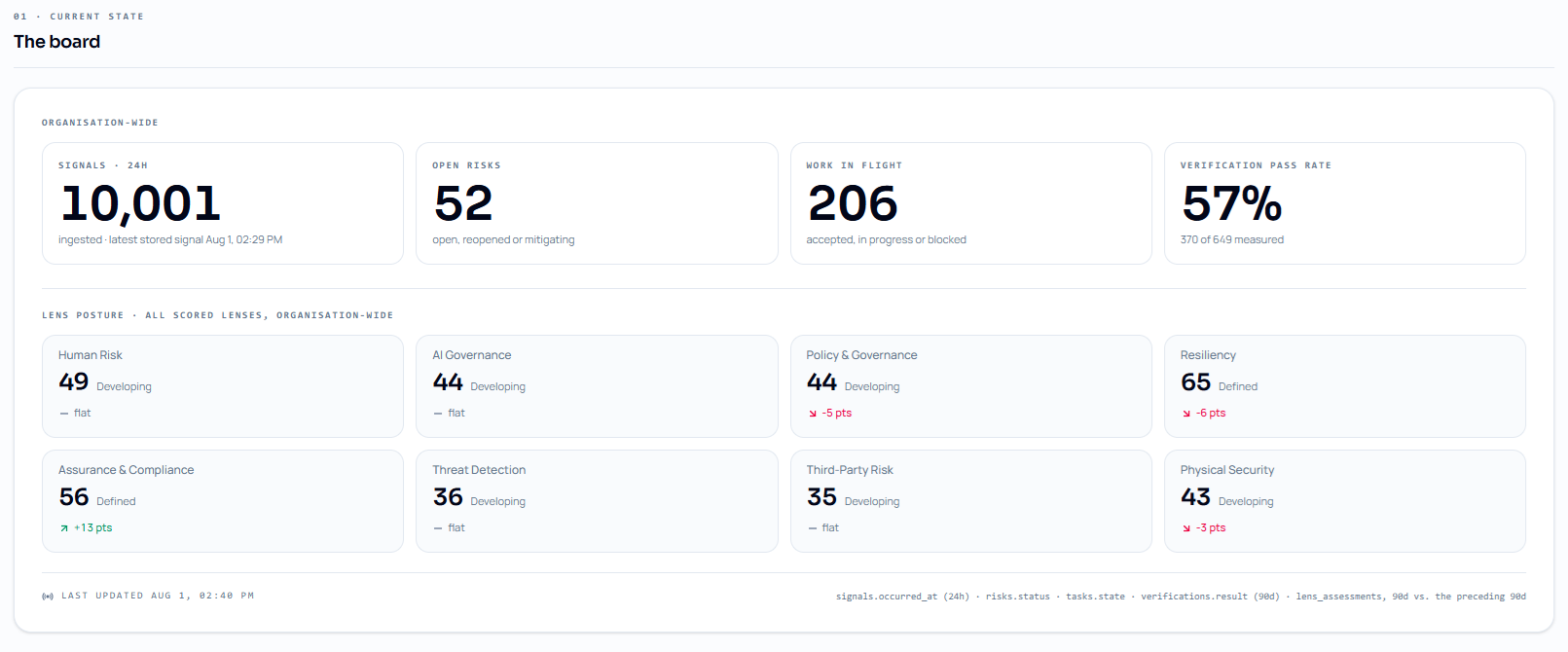
One position, scored, and the surfaces that keep it honest.
Real captures from the live application, taken against a demonstration tenant. Nothing here is a mock-up. Select any capture to enlarge it.
Nothing to install.
Two quarters already recorded.
The demo is a fictional industrial company with two quarters of coherent activity across sixteen role-based seats, signals, matched playbooks, completed work, and verification results including the ones that regressed.
It asks for a name and a work email. That is a lead gate, and we would rather say so than pretend otherwise: it tells us which seats people actually open, and it is how we know to follow up. Nothing is installed and nothing connects to your systems.
- Security operations
- Governance, risk and compliance
- Identity and access
- Security awareness
- Threat intelligence
- Data protection
- OT security
- Physical security
- Chief Information Security Officer
- Chief Information Officer
- Chief Executive Officer
- Chief Risk Officer
- Chief Operating Officer
- Chief Financial Officer
- Chief People Officer
- General Counsel
The method does not change. Only who runs it.
Licence the platform, run it with us alongside you, or hand the programme over.
Platform
IO™ licensed to your team. Your people execute the playbooks IO prescribes.
Platform + Enablement
The platform plus IO Enablement Services, assessments, programme design, workshops and advisory alongside your team.
Managed
Fractional leadership and managed programmes. IO executes and reports against the measure.
Jacob Revord
I spent twenty years inside military intelligence and enterprise security leadership, and most of it watching capable leaders drown in dashboards. Every quarter produced more telemetry and less certainty. Nobody could answer the only question that really mattered: did the thing we do actually work? IO exists because that question deserves a clear answer, in writing, including the quarters where the answer is no.

We are onboarding a small number of design partners.
Early deployment, direct influence over the roadmap, and Jacob in the room. It is a working commitment on both sides, not a discount scheme.
See it before you talk to anyone.
Two quarters of recorded activity, including the results that went the wrong way. One click, no install.